Home / Blog / Image Translation / Video Translation / Support / Donation / RSS
Free Alternatives to SDL Trados
SDL Trados is a computer-aided translation tool. It is the industry standard. Almost everyone in the localization industry has learned it.
It features translation memory, terminology management, support for various file formats, millions of options, and a community with industry expertise.
However, it is a bit complex and not cheap ($43/month for freelancer). There are various alternatives, like memoQ which has a lighter UI; Phrase (previous Memsource), which is a cloud platform. All have their uniqueness. But still, they do not meet my needs:
- Cross-platform desktop app supporting Linux, macOS and Windows. Completely offline.
- Easy to use interface.
- Easy extensibility.
OmegaT stands out as a free and open-source alternative and is cross-platform. But I don’t like its UI.
In the end, I created my own CAT tool with B4J, a RAD development tool. It is named BasicCAT.
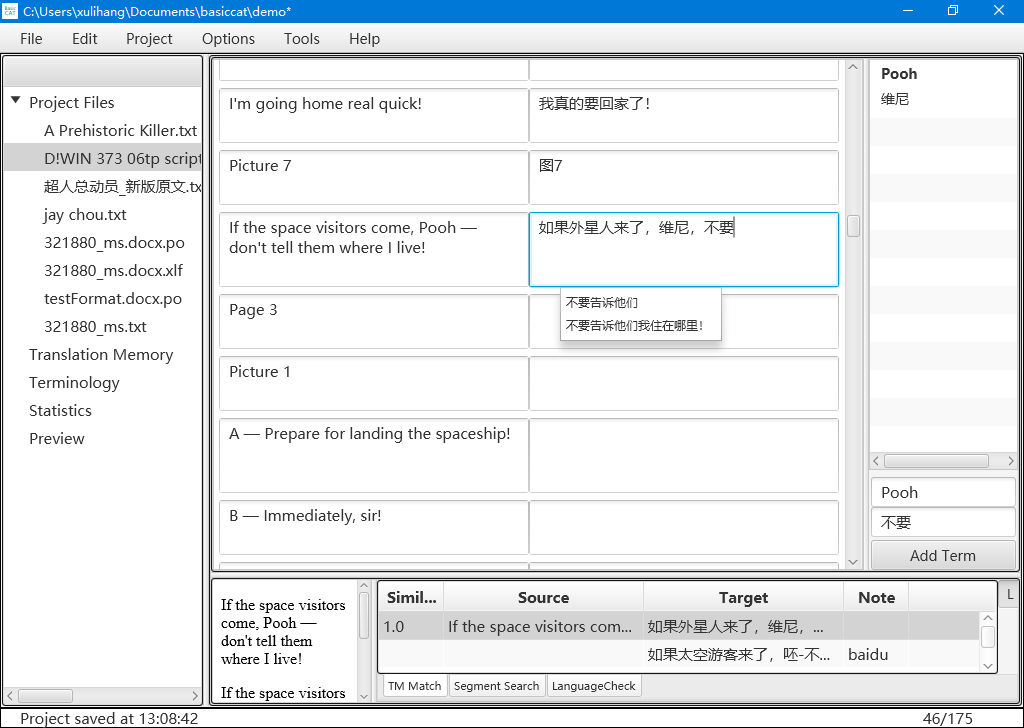
I have been developing BasicCAT since 2018. I’ve completed many translation tasks with it. Since it can directly translate Trados’s SDLXLIFF file, I can accept tasks requiring Trados even though I don’t have Trados.
In recent years, I mainly use it to translate the UI, website and documentation of my tools.
Its development has been stable. With the advent of large language models, I’ve added translation plugins to use ChatGPT, Gemini, DeepSeek, etc.
BasicCAT.org also provides other tools:
- Aligner: Bi-text aligner.
- ImageTrans is a computer-aided image translation and transcription (OCR) tool.
- Silhouette is a computer-aided translation tool for videos and audios.
These tools are a good company for freelance translators, translation hobbyists, teachers and students as well as companies.
In the AI era, every one can write his own translation app. But computer-aided translation is a complex field. Since BasicCAT is open source, we can create our own tool with the help of AI and BasicCAT as the foundation.
© 2026 BasicCAT ― Powered by Jekyll and Textlog theme